
What is AdBlue®

About AdBlue®
What is AdBlue®?
Let's Get to Know AdBlue®
AdBlue® is a non-toxic, environmentally friendly solution used to chemically reduce nitrogen oxide (NOx) emissions from diesel-powered heavy-duty vehicles. It is classified as a low-risk transportable fluid; however, due to its mildly corrosive properties, it must be handled and stored using specifically approved materials.
Across Europe, leading manufacturers of trucks, buses, tractors, and other vehicles equipped with Selective Catalytic Reduction (SCR) systems produce models that require the use of AdBlue®. The solution is stored in a dedicated tank—separate from diesel or other fuels—and is injected into the exhaust system via the SCR unit.
To ensure optimal performance and system integrity, AdBlue® must comply with strict international standards, including DIN V 70070, ISO 9000-2000, and TS-ISO-22241-1. It also fully adheres to both ISO and CEFIC guidelines. Using certified AdBlue® is essential for maintaining the efficiency and reliability of the SCR system.
AdBlue® technology enables vehicles to meet Euro 4 and Euro 5 emission regulations. As a 32.5% urea solution, AdBlue® is injected from the vehicle’s designated tank into the exhaust stream, where it reacts within the SCR catalyst to convert harmful nitrogen oxides into harmless nitrogen gas and water vapor.

Features
AdBlue® is a non-toxic solution that poses no harm to humans, animals, or the environment when handled correctly. With a pH level of approximately 9.5, it is mildly alkaline and should therefore be kept away from materials such as aluminum, brass, and mild steel. For safe storage and handling, the use of stainless steel or plastic containers and equipment is recommended.
Contact with skin and eyes should be avoided, as AdBlue® may cause irritation. Additionally, spills can create a slipping hazard. In case of spillage, clean-up should be done using mechanical methods, and the solution should be collected in appropriate containers for proper disposal. AdBlue® is non-flammable.
A) Storage and Handling Conditions
AdBlue® should be stored at temperatures between -10°C and +30°C, away from direct sunlight and outdoor exposure.
Contact with air should be minimized to preserve quality.
The product must be kept in tightly sealed stainless steel or polypropylene containers and used within one year from the production date.
All equipment used for transferring AdBlue® must be clean and hygienic.
B) Usage and Storage Conditions in Vehicles
AdBlue® used in vehicles must comply with TS ISO 22241-1 standards.
Proper hygiene must be maintained during handling and refilling.
The vehicle’s AdBlue® tank should be made from stainless steel or polypropylene and must be insulated to protect against extreme temperatures.
For vehicles parked for extended periods, the AdBlue® tank should not be left empty to prevent potential damage or contamination.
C) Benefits of Using AdBlue® in Diesel Vehicles
Converts harmful nitrogen oxides (NOx) into harmless nitrogen gas and water vapor
Provides up to 6% fuel savings
Helps prevent engine performance degradation
Contributes to cleaner air and a healthier environment

Why Was AdBlue® Needed?
In an effort to minimize the environmental impact of exhaust emissions, vehicle emission limits were established under European Union (EU) regulations. To comply with Euro 4 and Euro 5 standards, major heavy-duty vehicle manufacturers developed Selective Catalytic Reduction (SCR) engine technology and began producing diesel vehicles designed to meet these emission targets.
By the end of 2006, diesel vehicles equipped with SCR systems were introduced to the Turkish market, driving a significant increase in demand for AdBlue® as a vital component in emission control systems.

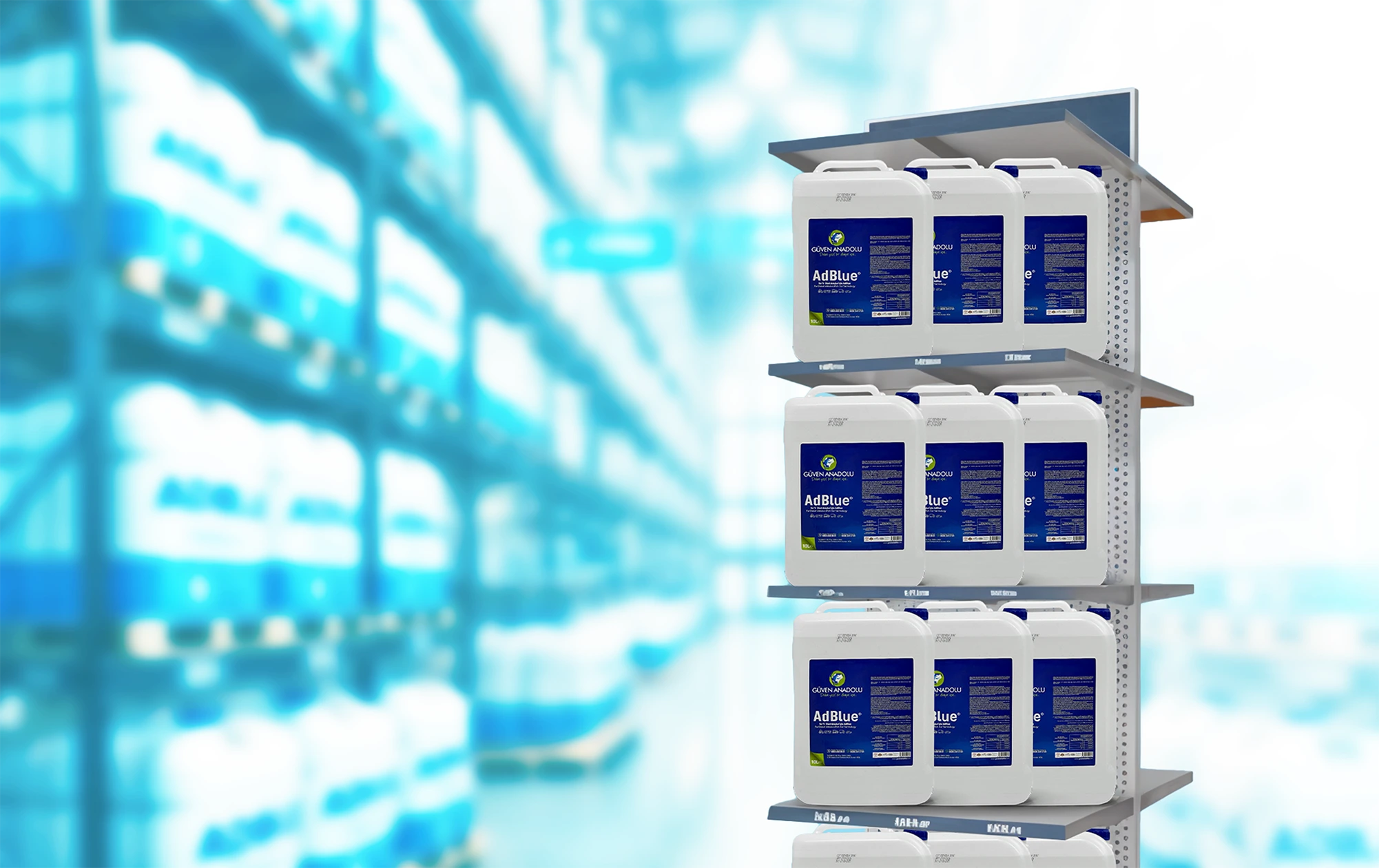
Storage Conditions of AdBlue®
AdBlue® has a shelf life of up to 12 months when stored in a cool, dry, and shaded environment at temperatures between -10°C and +30°C. It must be protected from direct sunlight, as prolonged exposure to temperatures above 30°C can lead to hydrolysis, which shortens the product’s shelf life and reduces its performance.
AdBlue® begins to freeze at -11.5°C, but once it is properly thawed, it can be reused without any loss in quality or effectiveness.
What Happens When AdBlue® Runs Out in a Vehicle?
SCR System
Selective Catalytic Reduction (SCR) technology is an advanced exhaust after-treatment system designed to reduce harmful nitrogen oxide (NOx) emissions. When diesel fuel is combusted in the engine, it produces exhaust gases containing pollutants such as NOx. In vehicles equipped with SCR systems, AdBlue® is injected into the exhaust stream before the gases reach the catalyst.
Under high temperatures, AdBlue® decomposes into ammonia (NH₃), which then reacts with NOx in the SCR catalyst, converting it into harmless nitrogen (N₂) and water vapor (H₂O).
If the AdBlue® level drops below the required threshold, the SCR system cannot operate effectively, leading to an increase in NOx emissions. Modern vehicles are equipped with on-board diagnostic systems that alert the driver when AdBlue® levels are low. If the AdBlue® tank is completely empty, the vehicle may fail to start or enter a reduced power (limp) mode.
Therefore, it is essential to regularly monitor and refill the AdBlue® tank to ensure proper vehicle performance and compliance with emission regulations.
EU Standards
The European Union has implemented strict regulations requiring all new diesel vehicles to comply with specific emission standards, which are uniformly enforced across all member states.
Euro 4, which came into effect in October 2006, set a limit of 3.5 g/kWh for nitrogen oxide (NOx) emissions.
Euro 5, mandatory from October 2009, further reduced this limit to 2.0 g/kWh.
These progressive standards are designed to minimize the environmental impact of diesel engines and to promote cleaner air and public health protection throughout Europe.
What Are the Consequences of Using Unlicensed AdBlue® Products?
AdBlue® is produced using a specially formulated, high-purity grade of urea specifically designed for automotive applications. Products made from agricultural-grade urea typically have lower urea concentrations and may contain impurities such as heavy metals, which can compromise the functionality of the vehicle’s SCR (Selective Catalytic Reduction) system.
Using such substandard solutions may lead to malfunctions in the SCR system and excessive AdBlue® consumption. Moreover, when exhaust gases are not treated at the correct time or efficiency within the catalyst, back pressure may occur, potentially resulting in engine performance issues or damage to engine components.


Advantages of Adblue®
AdBlue® is a liquid used in diesel vehicles that plays a critical role in reducing air pollution. While its use is largely mandatory across European countries, it has also become increasingly common in Turkey.
In vehicles equipped with AdBlue® systems, exhaust gases resulting from diesel combustion are chemically treated and converted into harmless water vapor before being released into the atmosphere. Without AdBlue®, emission levels can exceed legal limits, potentially leading to reduced engine performance and, over time, complete engine failure.
Since AdBlue® is a corrosive substance, it is never mixed directly with diesel fuel. Instead, vehicles are equipped with a dedicated AdBlue® tank, designed specifically for the safe storage and injection of the solution. To maintain proper system functionality and emissions control, this tank must be regularly filled with the correct amount of high-quality AdBlue®.
Adblue® Usage Areas
Application Areas of AdBlue®
In recent years, a range of measures have been introduced to prevent diesel vehicles from exceeding emission limits and to reduce their environmental impact. Among the most effective of these is the use of AdBlue®, which has become essential in emission control systems.
AdBlue® is used in all diesel-powered vehicles and is particularly crucial for Euro 6-compliant engines, where its use is virtually mandatory.
For a medium-powered diesel vehicle, approximately 40 liters of AdBlue® is required for every 1,000 liters of diesel fuel. On average, AdBlue® consumption accounts for 4% to 6% of total diesel usage, depending on the engine power and the vehicle’s emission standard.
While AdBlue® is already widely adopted in heavy-duty commercial vehicles, automotive manufacturers are increasingly working to extend its use to smaller diesel engines and passenger vehicles as part of a broader strategy to meet stricter emission regulations.


08.
Adblue Fiyatları
Adblue fiyatları hakkında net bir rakamdan söz etmek mümkün değildir. Zira bu ürünün satışını yapan firmaların uyguladıkları farklı fiyat politikalarından dolayı sürekli olarak fiyatta bir değişkenlik söz konusudur. Otomobil Endüstrisi Derneği (VDA) tarafından tescilli bir ürün olan Adblue hemen hemen tüm bayilerde birbirine yakın fiyatlardan satılmaktadır. Adblue fiyatları sağladığı avantajlar ile kıyaslandığı zaman son derece uygundur. Adblue fiyatları üzerinde etkili olan bir diğer husus da bu konuda üretim yapan markaların son dönemde sayısının artmasıdır. Farklı firmalar tarafından üretilen adblue ürünlerinde, fiyat açısından da farklılıklar yaşanmaktadır. Ayrıca alınacak olan ürünün litre hacmi de fiyat üzerinde belirleyicidir.

